GRATs (Grantor retained annuity trusts)
Last updated: April 16, 2025
Grantor Retained Annuity Trusts (“GRAT”)
A GRAT is a commonly used wealth transfer method for reducing the size of an individual’s taxable estate, and correspondingly the estate tax liability. By using a GRAT, asset appreciation may be transferred to beneficiaries free of gift and estate tax.
Why use a GRAT?
GRATs are useful in situations where an individual is likely to be subject to federal estate tax at death because the individual’s estate value currently exceeds, or is expected to exceed, the federal applicable exclusion amount (also known as the estate tax exemption).¹
The GRAT is a trust strategy designed to reduce future estate tax exposure while not requiring the asset owner to make an irrevocable gift of the initial principal value transferred. By transferring the appreciation of assets to beneficiaries, the GRAT effectively “freezes” the individual’s estate value at today’s value, which can minimize estate taxes.
Potential benefits
Gift tax free transfer: GRATs can be structured to pass assets to beneficiaries so that there is little to no gift tax.
Reduce estate tax liability: GRATs can minimize potential estate tax liability by moving asset appreciation and future income out of a taxable estate.
Income tax free growth: A GRAT is a “grantor trust,” meaning that the trust’s income tax liability is paid by the creator of the GRAT, thereby enabling the GRAT to accumulate value on an income tax free basis.
“Heads you win, tails you don’t lose”: If GRAT performance exceeds the designated 7520 rate (the “hurdle rate”), assets pass to beneficiaries free of gift tax. If GRAT performance does not exceed the hurdle rate, all assets are distributed back to the grantor, and the grantor is in the same position they would be had they done nothing (less any costs associated with implementing the strategy).
Potential drawbacks
Grantor lifetime considerations: The grantor must survive the GRAT term for the strategy to be successful. If the grantor dies during the GRAT term, trust assets are transferred back into the grantor’s estate and are subject to estate tax.
Learn more about term selectionGeneration skipping transfer: GRATs are not good for making gifts to grandchildren or later generations, as remainder interests are likely to be subject to GST tax.
Learn more about GSTPrivate asset utilization: Annual asset valuations are required to make annuity payments to the grantor, which can be costly and administratively burdensome if the GRAT is funded with infrequently valued or hard to value assets (i.e., privately held investments).
Learn more about asset selection
How a GRAT works
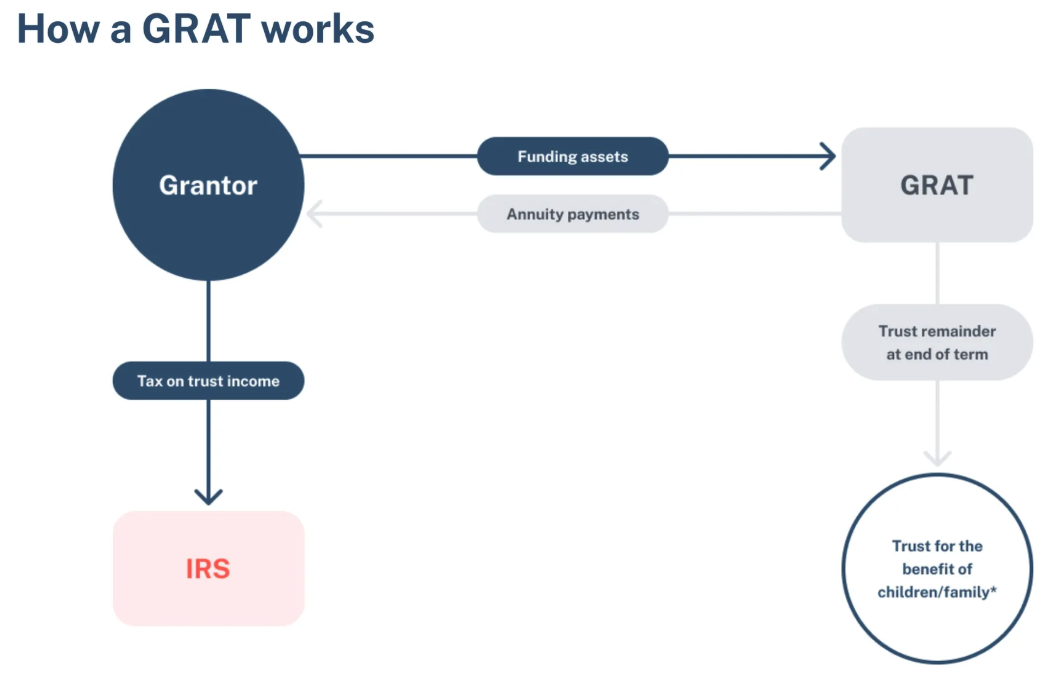
The grantor transfers assets into the GRAT and specifies:
A. The term length of the GRAT
B. The total annuity payments the grantor will receive during the term
C. The remainder beneficiary(ies) upon GRAT termination
During the term, the grantor receives an annuity stream. The amount of the grantor’s annuity payments is calculated at the creation of the GRAT using the funding value of the assets at the time of the transfer.
A. The GRAT is a split-interest trust, having 2 distinct property interests: (i) the grantor’s annuity interest during the GRAT term; and (ii) the beneficiary’s remainder interest after the GRAT terminates.
B. To avoid a gift tax, the remainder interest must have a zero value. To achieve this, GRATs can be structured to “zero out” the remainder interest by having the grantor’s total annuity payments equal the initial principal funding amount plus the required 7520 rate interest (the 7520 rate is issued monthly by the IRS).
The GRAT’s trust income taxes are paid by the grantor during the GRAT term which allows GRAT assets to accumulate value on an income tax free basis.
If GRAT assets appreciate above the hurdle rate (the 7520 rate) the strategy is expected to be successful.
When the GRAT terminates, the grantor’s annuity stream ends and remaining GRAT assets — i.e., the appreciation above the hurdle rate — pass to the remainder beneficiary free of gift taxes.
Bottom line: is a GRAT right for me?
“I want to give to my children or other family members”
Benefitting children & other family: GRATs can be used to make tax free gifts to children and other family members such as siblings, parents, and nieces/nephews in the same generation as children. GRATs are not a tax efficient way to pass wealth to grandchildren or later generations.
“I want to give more if my portfolio performs well”
Retaining principal: GRATs can be very effective for transferring appreciation of portfolio assets to beneficiaries while retaining the principal value of your portfolio.
“I own assets that are likely to have significant growth potential”
Funding Assets: Funding GRATs with assets expected to have high growth potential during the GRAT term can maximize the opportunity for wealth transfer.
“I have a taxable estate or expect to have a taxable estate in the future”
Taxable estate: If a taxable estate is anticipated, a GRAT can be useful for reducing estate tax exposure.
“I have used all of my gift exemption or plan to use it for another purpose”
“Zeroed out” GRATs: GRATs can be structured to have little or no gift tax value so that no gift tax is due and no gift exemption will be used.
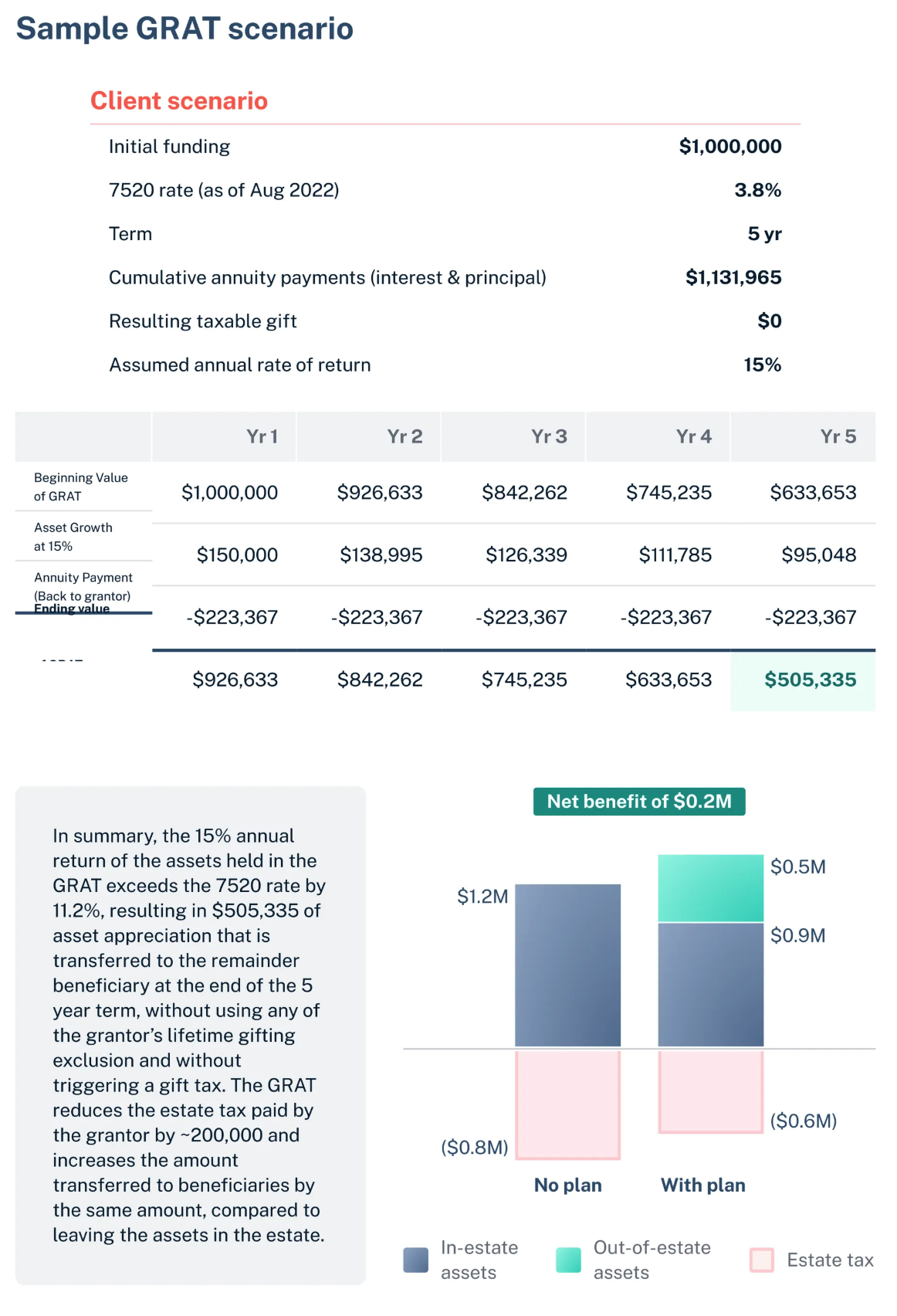
Additional considerations
Gift Tax Return: A federal gift tax return (form 709) should be filed in the year following the transfer to disclose the GRAT transaction to the IRS.
Grantor trust status: Since the grantor is obligated to pay the GRAT’s trust income taxes, it is necessary to ensure that the grantor has sufficient liquid assets to pay the taxes during the GRAT term.
Remainder beneficiary distribution: The GRAT’s remainder interest can either be distributed outright to the beneficiary, or if preferred, the remainder interest can be distributed to a separate receiving trust with designated beneficiaries (“remainder trust”). The remainder trust can be structured as a grantor trust to achieve further tax benefits.
Learn more about grantor vs. non-grantor trusts
¹ In 2023, an estate value over $12.92 million per individual (or $25.84 million per married couple) is subject to federal estate tax. This amount is indexed for inflation. Under current law, the exemption will revert to $5 million per individual (indexed for inflation) in 2026. Additionally, individuals living in the following states may be subject to state estate or inheritance tax: District of Columbia, Hawaii, Illinois, Iowa, Kentucky, Maine, Maryland, Massachusetts, Minnesota, Nebraska, New Jersey, New York, Oregon, Pennsylvania, Rhode Island, Vermont, and Washington.
Powered by Luminary
Luminary does not provide legal or tax advice. Consult with your legal and tax professionals prior to making any estate planning decisions.